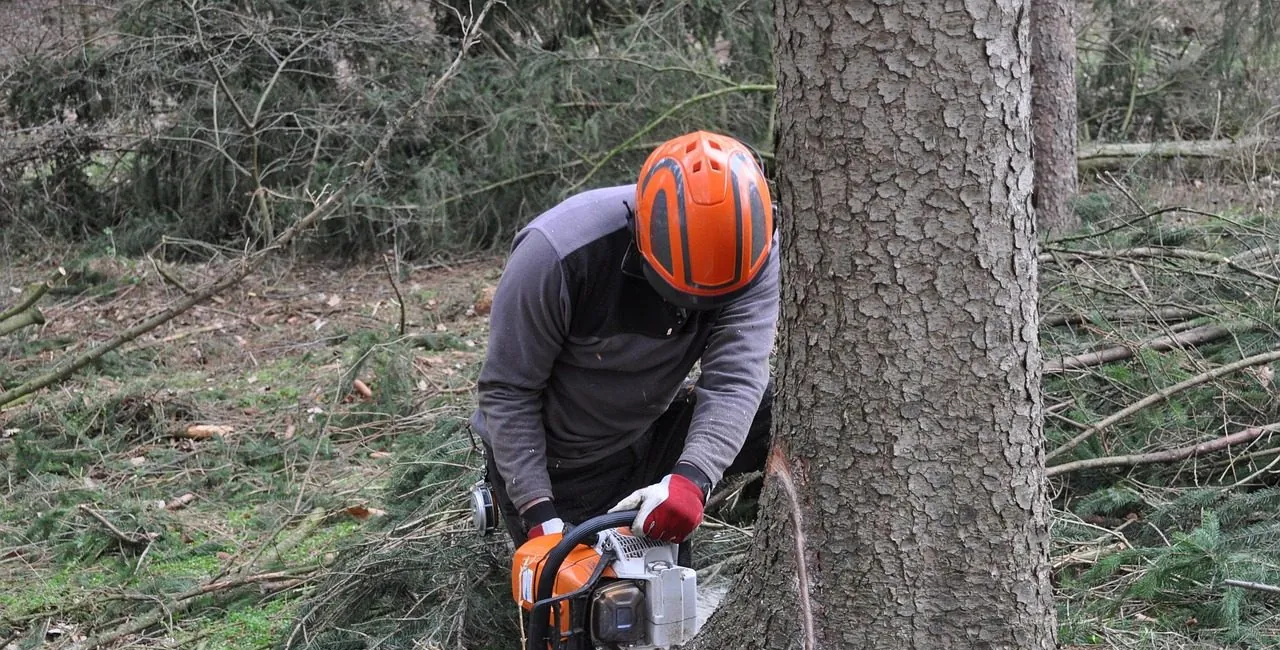
Tree removal in Ocala, FL starts with one question: city or county?
Before anyone prices a tree, find out who governs the lot. Inside Ocala city limits, the Growth Management Department's application says a permit is needed for any tree 4 inches or more in diameter, regardless of species or condition. The fee is $100, review takes at least 10 business days, and the permit is issued to the contractor. Lots zoned R-1, R-1A or R-1AA, under 3 acres and holding an existing single-family home, are excepted. Out in unincorporated Marion County, protection starts at 10 inches DBH, and a parcel used for a single-family house is on the county's exemption list. The permits page sets both side by side.
What the work tends to cost
We found no published Ocala price list, so the closest Florida metro numbers are Angi's Orlando guides. Tree removal there runs $203 to $2,028, averaging $761. Height matters a lot in Angi's table: $160 to $300 for a tree up to 30 feet, $1,100 to $1,800 for one past 80 feet. Oaks are listed at $700 to $1,100 and pines at $1,100 to $1,800. Angi adds that trees near power lines or buildings can push the bill up by as much as 50 percent, and Angi prices stump grinding on its own at $155 to $510 a project. More on the cost page.
Laurel oaks, live oaks and pines
Two Florida oaks age very differently. UF/IFAS gives the laurel oak a life span of 50 to 70 years and says a small trunk wound or a poor pruning cut can start a column of decay 10, 20 or more feet long inside it. Live oak resists decay better and lives longer. The University of Florida's storm-damage pages say older laurel and water oaks fell more often than other trees in hurricanes. If a laurel oak planted when the neighborhood was built is dropping big limbs, read the laurel oak guide before deciding.

Hurricane years: Irma, Ian and Milton
Hurricanes still reach Ocala. During Irma in September 2017, WFTV reported many trees down on power lines across Marion County, traffic signals out countywide and 6 to 10 inches of rain. Ian in 2022 caused relatively little damage to the county, according to the Ocala Gazette, though it still cost the city an estimated $455,452, mostly in salaries and overtime. Milton in October 2024 left 46,962 Marion County customers without power, and WCJB found homes with fallen trees in southeast Ocala neighborhoods. Before any storm cleanup, look for downed wires; storm and emergency tree removal covers what to do first.
Trees tangled with power lines
Ocala Electric Utility says trees growing near lines are a leading cause of outages, and it prunes and removes hazardous trees along about 200 miles of line every year. Before any tree trimming starts on a tree that touches a line, OEU asks customers and tree contractors to call for a free onsite visit with its arborist; the utility may drop the line, or cut enough that a private contractor can safely finish. Duke Energy, SECO Energy and Clay Electric also serve parts of the county. See trees near power lines.
Stumps, roots and buried lines
Stump grinding means cutting into the ground, and Sunshine 811 asks for at least two full business days' notice before digging so buried utilities can be marked. Florida's homeowner exemption only reaches 10 inches deep, and grinding below grade can go past that. Angi's Orlando stump figures average $389 per job, with prices rising by stump diameter. See stump grinding.
Where the brush goes
Ocala picks up yard waste once a week, but limbs must be cut to four-foot lengths and stacked apart from leaves and grass, and any pile over 5 cubic yards becomes a billable load starting at $41.25. Tree debris created by a contractor isn't the city's to collect at all. In unincorporated Marion County there's no curbside pickup, and the county's recycling centers turn away commercial waste. Either way, whether it's one tree or full land clearing, ask each contractor whether hauling or chipping is in the price; Angi's Orlando figures put chipping at an average of $95.
Timing around the wet season
Ocala averages 51.64 inches of rain a year, and June through September are the wettest months. Prices move with demand too: Angi's Orlando debris guide notes costs can spike after a major storm and suggests that, if a tree is safe to leave, waiting a week or more may cost less. A tree that is cracked, hanging or leaning toward the house is a different matter and is worth a call now.